

1 Hexene Density G Ml
 | |
 | |
| Names | |
|---|---|
| Preferred IUPAC name Hex-1-ene | |
| Other names Hexene, Hexylene, Butyl ethylene | |
| Identifiers | |
| CAS Number |
|
| 3D model (JSmol) |
|
| ChEBI |
|
| ChEMBL |
|
| ChemSpider |
|
| ECHA InfoCard | 100.008.868 |
| EC Number |
|
| PubChem CID |
|
| RTECS number |
|
| UNII |
|
| Un number | 2370 |
| CompTox Dashboard (EPA) |
|
| InChI
| |
| SMILES
| |
| Properties | |
| Chemic formula | C 6 H 12 |
| Molar mass | 84.162 thou·mol−1 |
| Appearance | Colorless liquid |
| Density | 0.673 thousand/cm3 |
| Melting bespeak | −139.viii °C (−219.six °F; 133.3 K) |
| Boiling point | 63 °C (145 °F; 336 K) |
| Solubility in h2o | Insoluble |
| Viscosity | 0.51 cP (0.51 mPa·south) at 28°C |
| Hazards | |
| GHS labelling: | |
| Pictograms |    |
| Signal word | Warning |
| Hazard statements | H225, H304, H319 |
| Precautionary statements | P210, P233, P240, P241, P242, P243, P264, P280, P301+P310, P303+P361+P353, P305+P351+P338, P331, P337+P313, P370+P378, P403+P235, P405, P501 |
| Safety data sheet (SDS) | External MSDS |
| Supplementary information page | |
| 1-Hexene (data page) | |
| Except where otherwise noted, data are given for materials in their standard state (at 25 °C [77 °F], 100 kPa). Infobox references | |


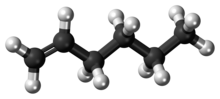
i-Hexene (hex-ane-ene) is an organic chemical compound with the formula C6H12. Information technology is an alkene that is classified in industry as higher olefin and an alpha-olefin, the latter term significant that the double bail is located at the alpha (primary) position, endowing the compound with higher reactivity and thus useful chemical backdrop. ane-Hexene is an industrially significant linear alpha olefin. one-Hexene is a colourless liquid.
Production [edit]
1-Hexene is unremarkably manufactured by ii full general routes: (i) full-range processes via the oligomerization of ethylene and (ii) on-purpose technology. A minor road to 1-hexene, used commercially on smaller scales, is the aridity of hexanol. Prior to the 1970s, i-hexene was besides manufactured past the thermal cracking of waxes. Linear internal hexenes were manufactured by chlorination/dehydrochlorination of linear paraffins.[one]
"Ethylene oligomerization" combines ethylene molecules to produce linear alpha-olefins of various concatenation lengths with an fifty-fifty number of carbon atoms. This approach result in a distribution or "total range" of alpha-olefins. The Shell college olefin process (SHOP) employs this approach. Linde and SABIC take developed the α-SABLIN engineering science using the oligomerization of ethylene to produce 21 percent i-hexene. CP Chemicals and Innovene as well take full-range processes. Typically, 1-hexene content ranges from about xx per centum distribution in the Ethyl (Innovene) process, whereas only twelve percent of distribution in the CP Chemicals and Idemitsu processes.
An on purpose road to 1-hexene using ethylene trimerization was get-go brought on stream in Qatar in 2003 by Chevron-Phillips. A 2d establish was scheduled to start in 2011 in Saudi Arabia and a third planned for 2014 in the US.[2] The Sasol process is also considered an on-purpose road to 1-hexene. Sasol commercially employs Fischer–Tropsch synthesis to brand fuels from synthesis gas derived from coal. The synthesis recovers ane-hexene from the aforementioned fuel streams, where the initial i-hexene concentration cutting may be 60% in a narrow distillation, with the balance existence vinylidenes, linear and branched internal olefins, linear and branched paraffins, alcohols, aldehydes, carboxylic acids, and aromatic compounds. The trimerization of ethylene by homogeneous catalysts has been demonstrated.[iii] An culling on-purpose route has been reported by Lummus Engineering science.[4]
Applications [edit]
The primary use of ane-hexene is equally a comonomer in production of polyethylene. High-density polyethylene (HDPE) and linear low-density polyethylene (LLDPE) use approximately ii–four% and 8–10% of comonomers, respectively.
Another significant utilise of ane-hexene is the production of the linear aldehyde heptanal via hydroformylation (oxo synthesis). Heptanal can be converted to the brusk-concatenation fatty acid heptanoic acid or the alcohol heptanol.
The chemical is used in the synthesis of flavors, perfumes, dyes and resins.
Hazards [edit]
1-Hexene is considered unsafe considering in liquid and vapor grade it is highly flammable and may be fatal if swallowed and enters airways.
The widespread use of 1-hexene may result in its release to the surround through various waste product streams. The substance is toxic to aquatic organisms.[5]
References [edit]
- ^ Lappin, George (Editor), Alpha Olefins Applications Handbook, Marcel Dekker Inc., ISBN 978-0-8247-7895-8
- ^ (18 October 2010) Chevron Phillips Chemic announces plans for world-scale one-hexene plant Archived 2014-11-29 at the Wayback Machine Plastinfo, Plastics Industry Directory, Retrieved 30 September 2011
- ^ David S. McGuinness, Peter Wasserscheid, Wilhelm Keim, David Morgan, John T. Dixon, Annette Bollmann, Hulisani Maumela, Fiona Hess, and Ulli Englert "Showtime Cr(3)−SNS Complexes and Their Apply equally Highly Efficient Catalysts for the Trimerization of Ethylene to ane-Hexene" J. Am. Chem. Soc., 2003, volume 125, pp 5272–5273. doi:10.1021/ja034752f.
- ^ "To make better decisions, you lot need to run into the large picture".
- ^ "1-Hexene". PubChem. National Institutes of Wellness. Retrieved 21 January 2019.
External links [edit]
- Chemical Database, i-Hexene [ permanent dead link ]

1 Hexene Density G Ml,
Source: https://en.wikipedia.org/wiki/1-Hexene
Posted by: madsenreflonch.blogspot.com
0 Response to "1 Hexene Density G Ml"
Post a Comment